
In industrial situations, time is money. Any additional steps to add will leave room for issues and errors to occur. Additional processes such as laminating, waiting for the adhesive to dry and fixing bubbles will cause delays and increase costs.
However, using Pre-Laminated MDF boards will reduce many of these steps. The boards have already been manufactured at the manufacturing site with a layer of melamine bonded to give a surface. This means your team can begin edge banding, cutting and assembly. This will improve consistency within large batches and reduce production time.
Below we have outlined more about the boards, and their limitations to ensure they are suitable for your line.
Key Points
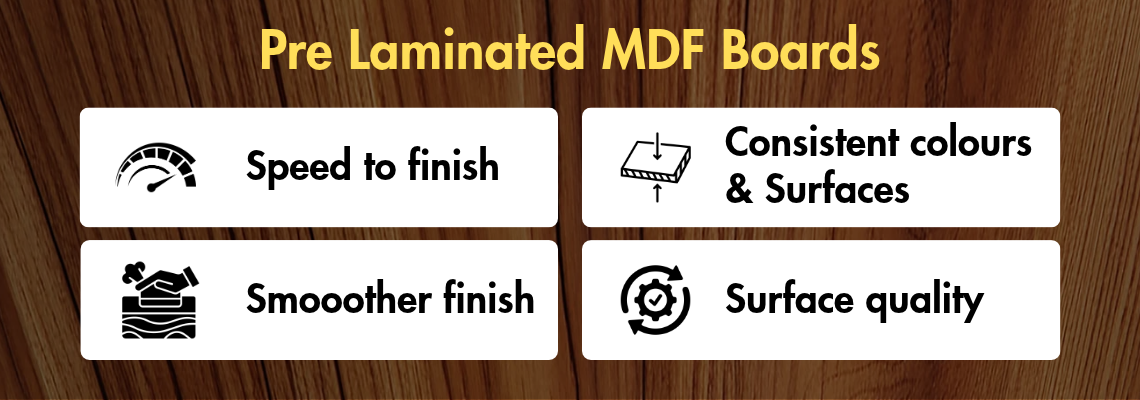
- Speed to finish – You are able to move onto edge banding and assembly quicker.
- Consistent colours and surfaces – Laminate in-house will give a more consistent colour and surface across larger batches.
- Smooother finish – Compared to particle board, MDF has a finer grain core to allow clean shutters and profiled edges.
- Some MDFs are water resistant, but like most they will not be completely waterproof. Edge sealing will be essential when using in humid areas.
- Compare landed costs and samples from recent batches from your suppliers.
Pre Laminated MDF Boards
Pre laminated MDF boards are a type of board made with a core of medium density fibreboard with a decorative or melamine resin paper bonded to one or both sides.
These boards can be referred to as:
- Pre laminated MDF sheets
- Melamine laminated MDF boards
- Laminated MDF sheets
Although these can often be the same product, it is best to always check with your supplier to confirm.
How Are Pre Laminated MDF Boards Different from Plain MDF?
| Feature | Plain MDF | Pre laminated MDF |
| Surface | Bare, needs paint, veneer or laminate | Finished décor, ready to use |
| Extra process needed | Pressing or painting | Edge banding only |
| Production time | Longer | Shorter |
| Finish consistency | Depends on your in-house process | Controlled at the factory |
| Flexibility of finish | High, any finish on any job | Limited to available décors |
From a practical standpoint, using plain MDF would be best if you intend on painting, veneering or adding a special laminate on. Pre laminated MDF should be used if you want a standard finish and will be repeated.
Benefits of using Pre Laminated MDF Boards
Reduced production time
As the boards are laminated in-house there is no waiting for drying time. No special laminating machines will be needed.
Better finish
Sometimes bubbles can form and edges can lift when laminating. These can happen even if you laminate correctly. Using boards laminated in-house can reduce some of these issues.
Consistent colours and texture
If you need multiple panels to match, for example in large batches, a consistent colour throughout your decor run will help provide a consistent finish. This is important if the units are going to sit next to each other.
Reduced re-work
Reducing finishing processes will reduce re-work. This will produce a more consistent product.
Where Do Pre Laminated MDF Boards Work Best ?
- Flat panels, shutters and carcasses – Kitchens, Offices, Wardrobes, Shop Fit Out.
- Wall linings, Cladding and Display Units.
- Edge profiled panels.
If you need edge profiles and price is not an issue then you may want to go with a structural panel, such as particle board.
Pre Laminated MDF vs. Plywood vs. Particle Board: Which Should You Use?
| Need | Better fit |
| Smooth, routable shutters and panels | Pre laminated MDF |
| Strong structural frames and load-bearing parts | Plywood |
| Budget-friendly carcasses in dry areas | Pre laminated particle board |
| Fine surface for profiles and grooves | Pre laminated MDF |
| High-humidity areas with good sealing | MR-grade MDF or marine-grade plywood |
Types of Laminated MDF Sheets
Most MDF sheets will come in multiple grades:
Standard
Moisture Resistant
Fire Retardant
Finnish can come in:
- Wood grains.
- Solid colours.
- Stone and other patterns.
- Textured and matte.
- High gloss.
The thickness can vary depending on what you need. Backs and linings can come in 1/8”. Shutter and Shelf boards can come in 3/8”. Please confirm with your supplier what sizes and thicknesses they can offer as it varies between different manufacturers.
Checking Quality of Pre Laminated MDF Sheets
Surface Quality
Angle the light over the sheet and look for any imperfections. Check for any inconsistencies in colour and texture. Look for pitting and scratching.
Lamination Quality
Look for any lifting or peeling around the corners and edges. If the lamination is poor you will see peeling around the edges first.
Core Quality
Take a sample and look at the edge. A good MDF core will have a tight smooth appearance and show no signs of hollows or loose fibres.
Tolerances
Measure different areas of your sheet, or different sheets to find an average tolerance. Tolerances will show in the gaps in your seams and edge banding.
Machinability
Test with a sample on your edge bander, computer numerical control (CNC)or Router. The laminate can flake around the edges.
Emissions
Ask for emissions. Formaldehyde can cause health issues and is a breach of building regulations. If you are doing institutional or residential work you will need to comply.
Are Pre-Laminated MDF Boards Waterproof?
No. Standard MDF will absorb water. MDF boards that are advertised as being waterproof are actually designed to withstand steam and humidity. They are moisture resistant.
To safely use laminated MDF in humid areas:
Ensure you have a MR grade.
Seal all cut edges.
Use ABS or PVC edge banding.
Avoid getting water onto the panels.
What affects the price of Pre-Laminated MDF Boards?
The following will influence how much you will be charged for a single price for your Pre-Laminated MDF Boards.
Grade – Standard, MR, FR.
Thickness – Thicker boards will be more expensive. Larger sheets will be more expensive.
Decors – Plain colours may be cheaper than wood grains and high glosses.
Single or double sided.
Quantity – Buying in bulk and repeat orders will give you better rates.
Delivery and Handling – MDF panels are large and heavy.
You will need to consider the panels as a whole.
Price of sheet + Delivery and Handling + Rejects/Wastage = Average price per usable panel.
Standard practice for repeat customers:
- Keep a sample of each batch.
- Measure the thickness of samples. Note any issues.
- Review performance every quarter.
FAQ
- What are pre laminated MDF boards used for?
They are used for cabinet and fitting panels with a finished surface.
- Is melamine laminated MDF the same as pre laminated MDF boards?
Yes. Pre laminated MDF boards are generally made from melamine impregnated decor paper.
- Are pre laminated MDF boards waterproof?
Standard MDF is hydroscopic. There are moisture resistant grades available but all edges will need to be sealed. - Do pre laminated MDF boards need edge banding?
Yes. The faces are finished but the edges will need to be banded.
- How can I compare the price of pre laminated MDF boards?
Compare grade, finish and thickness. Compare the landed price per usable panel factoring in freight and rejects.
- Is pre laminated MDF better than Plywood?
Pre laminated MDF is smoother, more consistent and easier to route. Plywood is better than MDF for load bearing and structural uses.
- Can pre laminated MDF sheets be used for kitchen cabinets?
Yes. As long as edges are sealed and no prolonged exposure to water.
- What should I check before ordering in bulk?
Check the core is consistent. Check the thickness. Check the quality of lamination and surface. Check the emissions documents.
Conclusion
Pre-Laminated MDF boards can be finished at the manufacturers or contractors site to save time and provide consistency. There are many benefits to using Pre-Laminated MDF boards, as long as you check the core and control the moisture. Ensure you are comparing the prices of usable panels.