
Key Takeaways
- Ensure batch consistency.
- Choosing a manufacturer will ensure consistency in specification and grade. Choosing a trader will give a wider variety of options.
- Ensure you know what you want. Ensure core density, edge quality, thickness tolerances and emission standards are met.
- Raw boards & pre-laminated boards will dictate your workflow. If you can laminate in house, then pre-laminate will be the option for you.
- Lowest landed cost per usable panel. Taking into account transportation, wastage and rejection.
- Test a sample from current production and order a trial.
What to Look for with Particle Board Suppliers?
Ensure you are working with a good supplier. They will be easy to verify with lots of technical information provided. They will be happy to answer any questions. Ensure there is evidence to back up what they are saying.
Ensure they have:
Product Specification. Thickness, Sheet Size, Grade & Density.
Quality. Test Reports & Emission Standards Certifications.
Stock Availability. Ensure you don’t have to chase for dispatch.
Good Technical Support. Ensure they are responsive.
If there is no specification sheet, this is a red flag.
Manufacturer or Trader: Which Is the Better Source?
Many buyers search for particle board manufacturers in India because they want to cut out the middle layer. That instinct is sound, but the right choice depends on your needs.
| Factor | Manufacturer | Trader or distributor |
| Specification control | Usually higher | Depends on source brands |
| Price at volume | Often more competitive | Can include extra margin |
| Product range | Limited to own range | Often multi-brand |
| Technical support | Direct from the source | Varies |
| Minimum order | Often higher | Often more flexible |
How to Choose a Particle Board Supplier in India?
Choose a supplier within your region. This will ensure you have quick and predictable lead times. Due to the size of the boards, the risk of damage will be higher.
Check:
- Where is the stock stored? How long will it take to get delivered?
- How are the panels packaged?
- How long does it usually take to dispatch repeat orders?
- Can they repeat the same grade & finish?
Consider regional availability.
What to Check for Quality?
Whilst it may cost to do lab tests, you don’t need to do anything special. These are simple checks to do and will give you a lot of information.
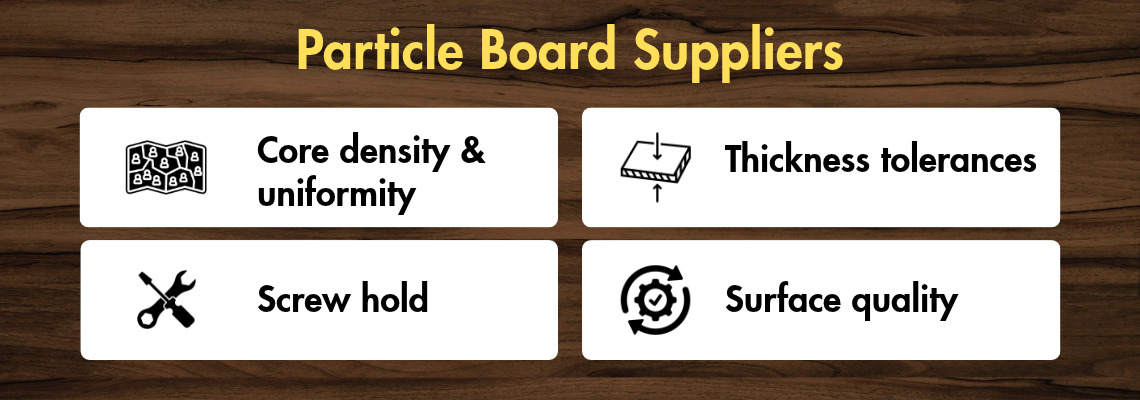
Core Density & Uniformity
Check the edge of a sample. A good core will be uniform and dense. There shouldn’t be any large soft spots, loose chips and/or large holes.
Screw Hold
Screw near the edge. A good core will hold the screw due to the density. A poor core will fall apart or the screw will spin.
Surface Quality
Check under angled lighting. There shouldn’t be any colour/pattern inconsistencies, scratches, pitting, dents etc.
Thickness Tolerances
Measure multiple points on the sheet and/or multiple sheets. Thickness can cause misalignment of joints and/or edge banding.
Moisture
Ask what grade they have available for humid climates. What grade do they recommend using in storage & kitchen areas? Beware any manufacturer claiming they are ‘Waterproof’.
Emissions
Ask for evidence of emission standards for formaldehyde.
What Grade Do You Need?
One of the most common and expensive mistakes is getting the wrong grade.
Standard – Suitable for dry internal areas such as wardrobes, bedroom furniture & office storage.
Moisture Resistant – Used in kitchens, bathrooms & humid areas. Has sealed edges.
Pre-laminated – Used in workshops.
As a rule of thumb, use the grade based on the room you’re using them in. Cheaper grades can be expensive if you’re using them in the wrong room due to callbacks.
Why Choose Pre-Laminated Particle Board Suppliers?
Since laminating is done in workshops, choosing a pre-laminated particle board supplier makes the process easier. The décor is already laminated in the factory. All you need to do is edge band and assemble.
Benefits:
- Saves time.
- Uniform colour & texture.
- No laminating equipment or labour required.
- Easier to plan and predict repeat orders.
Choose pre-laminated if you want repeatable results. Choose raw if you want flexibility.
As a dealer, pre-laminated boards will sell quickly when supplying modular furniture. However, you will need a wide range of décor. Ask your suppliers what finishes they can keep in stock.
Factors to Consider with Wholesale Particle Board Suppliers?
Price and reliability are equally important. Just because they are the cheapest doesn’t mean they are the best choice if they run out of stock.
Consider:
Minimum Order Quantity. How much do they want vs your storage space? How will this affect your cashflow?
Stock Availability. Can they supply you with enough stock during busy seasons?
Payment & Credit Terms. Are the terms fair?
Replacement Policy. What are the terms if they have a bad lot?
Delivery & Packaging. What are the terms if they deliver damaged?
Can they provide technical data? This will help your customers and therefore your supplier can help you. This will improve your reputation.
How to Compare Quotes?
There are many factors that can differ between quotes. Ensure you compare like for like. Check emissions, finish, thickness and sheet size.
Use this formula to calculate the landed cost per usable sheet:
Sheet Price +Estimated Cost of Delivery & Handling -Estimated Wastage & Rejection = Divide by the number of usable sheets.
Try to find a supplier that produce the least amount of rejected sheets. Many people waste money without knowing.
How to Find the Best Quality Particle Board Suppliers?
Everyone claims to be the best quality particle board suppliers Look for:
- Willingness to send samples & test data.
- Evidence of quality control during manufacturing.
- Clear answers to grade, density & emissions.
- References from other dealers & workshop owners. They will give you references if you ask.
- Complaint Handling.
The best indicator is how they act. Usually if they let you see the product there isn’t anything to hide.
Examples / Tips.
1: Testing Trial Order
A workshop orders a small trial lot. They measure the thickness of 10 sheets in 5 different places. They test the screw hold, edge banding on a sample unit. They track the rejections. The trial order is approved and they order the large quantity. This is a fictional example and there is no real world example based on this.
2: Landed Cost
Two suppliers give different prices for the sheet material. The dealer calculates the delivery cost. They estimate the wastage & rejections based on a sample. They can then decide which supplier is cheaper per usable panel. This is a fictional example.
Everyday / Repeat.
- Save a sample from each delivery.
- Note down readings & measurements.
- Assess how the supplier is performing.
FAQs
How do I know if they are reliable particle board suppliers?
Check specification sheets, quality, batch consistency, reliable delivery, good after sales. Test a sample from current production and order a small trial.
What is the difference between particle board manufacturers & traders?
Manufacturers produce the boards. This means they will have good control over the grade & specification. Traders will source from multiple manufacturers. This means they may have a wider range but less control over the grade & specification.
What should I check before ordering in bulk?
Check core density, screw hold, surface quality, thickness tolerances, edge quality, moisture content & emission levels. Check minimum order quantities. Check lead time and replacement terms.
Is pre-laminated particle board better?
This will depend on your situation. Pre-laminated can save you time and give you more uniform edges. However, if you laminate/veneer in workshops you may prefer raw.
How do I compare quotes from wholesale suppliers?
Compare grade, thickness & finish. Then compare landed costs per usable panel.
Is standard particle board waterproof?
No. Standard particle board can soak up moisture. If you need the board to be moisture proof you may need to go for a moisture resistant grade. However, the edges may soak up moisture.
How many samples should I test?
Ideally, test samples from multiple sheets in the same production batch. Even better to order a small trial.
What documents should they have?
Ask for a specification sheet, evidence of emission compliance and relevant test reports. Ensure you ask in writing.
Conclusion & CTA
Ultimately it all comes down to evidence. Ensure you test specification sheets, consider landed costs rather than surface price and take note of how they deal with questions. Batch to batch consistency will affect your margins and reputation.
Whether you are a retailer looking to stock your shelves or a workshop owner looking to plan your next run, working with a reliable supplier will reduce your waste and keep your customers happy.
Xylosuisse is an engineered wood panel supplier to dealers & manufacturers. For more information, samples or a quote please visit xylosuisse.in to contact us with your requirements for grade & thickness.