
Overview
No one is a stranger to delays in the furniture business. While wood is already cut to size, laminate may still be on the way, press line is full, or finish has bubbled. Each added step after the wood is cut increases the chance for rework.
Prelaminated particle boards skip most of those steps. The decorative surface is already laminated at the factory. Therefore, you can go straight to finishing and assembly. PEARL Prelaminated Particle Boards are made for this process. They provide a finished surface for modular furniture and are easy to use for furniture designers and interior designers.
This document will give you an insight into how they are made, where and when you should use them, how you can identify good quality ones and what affects the price.
Key Takeaways
- Pre-laminated boards have been pre-finished meaning that the laminating stage can be omitted by furniture designers.
- Pre-lam boards with melamine face are less likely to be stained or wear.
- The cut quality may not always be consistent so do not assume it is of an average thickness due to it being stated in the catalogue.
- Water resistant boards can be used in more humid environments but must have sealed edges.
- Pricing depends on core grade & thickness, décor and how many you order. Compare the overall cost of your finished product to determine the price.
- Ask for samples from the same batch you will be receiving.
What is Prelaminated Particle Board?
Prelaminated particle board is a type of particle board where a decorative paper is fused to each side and then pressed between the particle board core under heat and pressure. The paper used is impregnated with melamine resin, thus it is known as melamine face particle board as well.
It is listed as “prelam” board in the Indian subcontinent or as “prelaminated particle board sheets” elsewhere.
How it differs from raw particle board
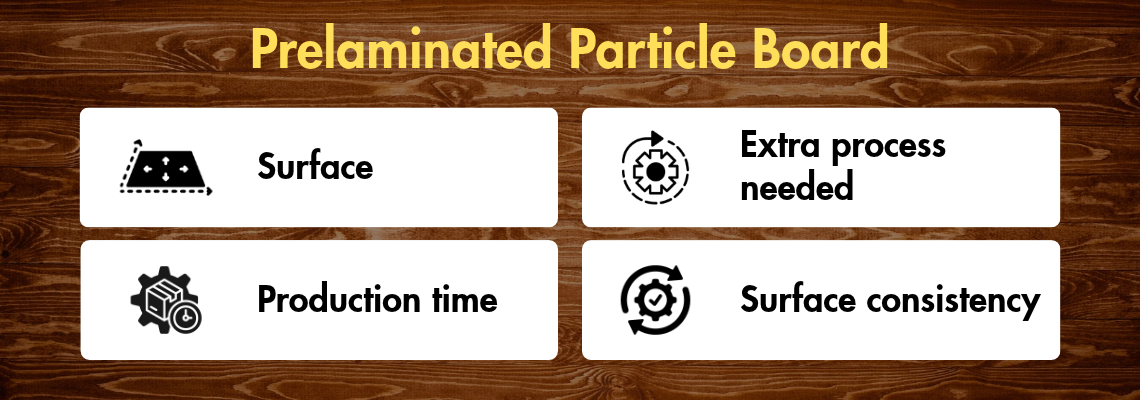
| Feature | Raw particle board | Prelaminated particle board |
| Surface | Bare, needs finishing | Finished décor, ready to use |
| Extra process needed | Laminate or veneer pressing | Edge banding only |
| Production time | Longer | Shorter |
| Surface consistency | Depends on your press line | Controlled at the factory |
What are the benefits of using prelaminated particle board for furniture?
Faster production
As there is no need to press and cure the prelaminated particle board it can be cut and then assembled straight away. Having no additional processes makes it very quick to make. This is great in a workshop where you may have repeat orders for certain pieces of furniture such as wardrobes/kitchen cabinets.
Design options
There are many design options when using pre-laminated sheets. This means that the furniture maker can choose a design for their piece to save them having to go to a separate laminate supplier.
Durability
Melamine is a durable surface which means it can handle everyday use. This makes it ideal for storage units, shelving units, wardrobes and more.
Where Does It Work Best?
Prelaminated particle board for furniture works best for:
- Modular wardrobes and storage units
- Kitchen carcasses and shutters (correct grade and sealed edges)
- Office desks, partitions and cabinets
- Shelving and display units
- Hostel, school and other furniture
It is not suitable for areas with standing water or constant wetting. For such areas, use another material.
Is There Such a Thing as Waterproof Prelaminated Particle Board?
This is perhaps the most popular question, and requires a direct answer. Standard particle board is not waterproof, and no core based on wood particles is waterproof.
What the market refers to as waterproof prelaminated particle board is normally MR grade. It employs a modified resin system and more water-tolerant surfaces to handle humidity, steam and water splashes.
Tips for humid and wet areas
- For core MR grade for kitchens and bathrooms.
- Seal all cut edges, especially around hinge holes and cut-outs for sinks.
- For edges use PVC or ABS banding and check if the bond is proper.
- Keep water panel panels away by using legs or plinths.
- Water almost always enters through unsealed edges and not through laminated faces.
How to Judge the Quality of Prelaminated Particle Board?
Surface Quality
Look for pits and scratches or discoloration under an angle light. “Orange peel” texture and inconsistent color are signs of a bad surface.
Lamination Bond
Check the edges for peeling and lifting. A poor bond shows up first at a cut edge.
Core Density and Screw Holding
A screw should be driven near the edge of a sample. The core should hold without crumbling.
Thickness Tolerance
The thickness of the sheet should be measured in several places. If there is a difference in the thickness, there will be problems with edge banding.
Emission Compliance
Ask for formaldehyde emission documents.
Edge Machining Behaviour
Run a sample through your edge bander. Look for lamination chipping at the edge.
What Affects the Price of Prelam Particle Board?
Factors that contribute to the variability in prelam particle board price include:
Core type: The cost of a moisture resistant board is greater than that of a standard board.
Thickness: The price of boards will vary depending on how much you want and what thickness you need (8mm, 12.5mm, 18mm, 25mm).
Decor and Finish: Wood grain or textured decor/finish will be more expensive than a plain surface.
Order Quantity: Large or repeat orders are usually granted a better price.
Logistics: The cost of transporting the board adds to the overall price.
Edge Rework: Edge-banding work increases the cost of each piece.
Rejections: A slightly higher price for a larger sheet may be more cost-effective if fewer pieces are rejected.
For current rates, contact your Xylosuisse Team with your thickness, grade, and quantity.
Why PEARL Pre-laminated Particle Board?
PEARL is perfect for those who design and create. If you are looking for information on PEARL, please contact Xylosuisse for details on:
- PEARL’s thicknesses and sheet sizes
- PEARL’s décor and finish
- PEARL’s core grades, including a moisture core
- PEARL’s emission certification
- Sample sheets and technical data
Frequently Asked Questions
What is prelaminated particle board and uses?
Prelaminated particle board is used in furniture construction where a finished surface is required, for example wardrobes, kitchen units, desks, and shelves.
Is melamine faced particle board the same as prelaminated particle board?
In the majority of cases, yes.
Can prelaminated particle board be used in kitchens?
Yes, as long as you use a moisture resistant grade, and seal all edges, and avoid direct, prolonged contact with water.
How do I compare prelam particle board prices with different vendors?
You first compare the grade, thickness, finish and emission certification. You then compare cost per finished unit (including wastage).
Is edge banding required for prelam particle board?
Yes, since the faces are finished, but the cut edges expose the core, and hence require banding for appearance and moisture protection.
Conclusion
Prelaminated particle board offers time and finish consistency with plenty of design flexibility. While examining the board, however, you need to be realistic about “waterproof” claims. For designers and makers seeking a finished board, PEARL Prelaminated Particle Board by Xylosuisse, should be on your shortlist. Request sample and quote at xylosuisse.in and test it on your production.