
Key Points
- Provides uniform colour and texture, particularly for large areas.
- Can be fluted, grooved and detailed with fine detail due to smooth cores.
- Ensure correct grade is chosen. Standard MDF is unsuitable for damp environments.
- Consider MDF as a finished sheet, and ply as a base.
- Consider cost per square metre installed.
- Always view a sample of the latest production.
Overview
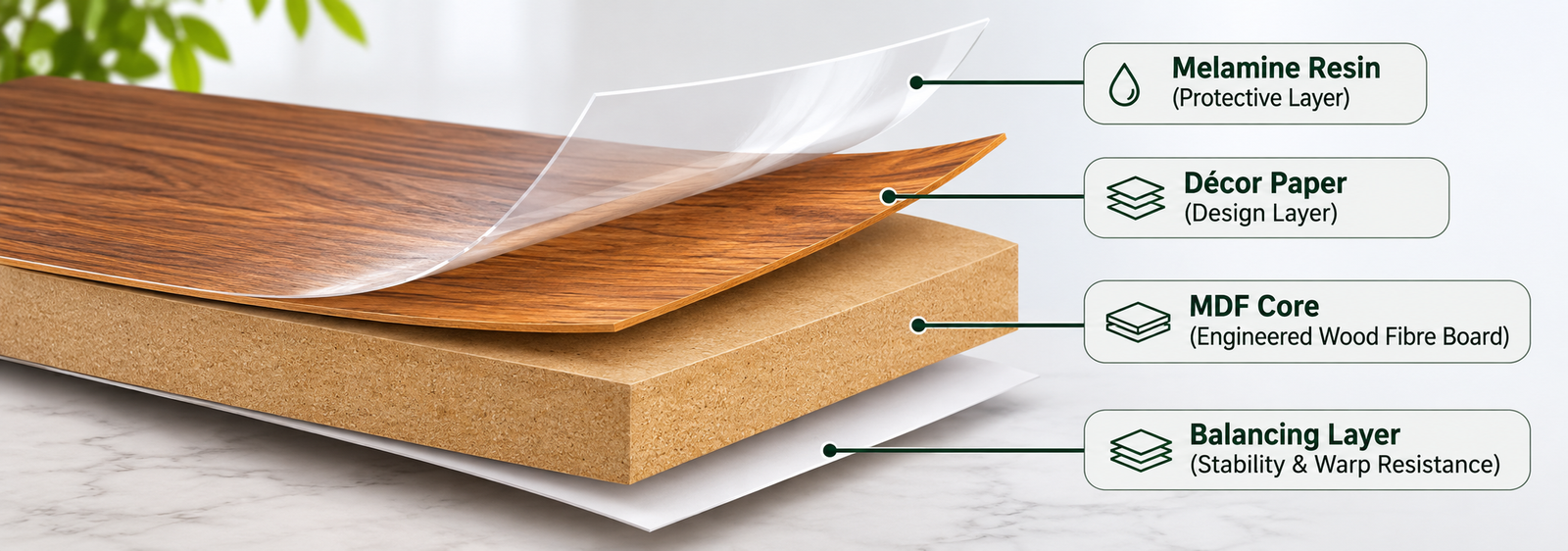
Laminated MDF sheets are produced by laminating decorative paper soaked in melamine resin to the surface (sides) of medium density fibreboard. Medium density fibreboard is produced from wood fibres and an adhesive, most commonly resins.
This can often be referred to by many different names. Pre-laminated MDF sheets or laminated MDF boards are trade names. Melamine faced MDF refers to the chemical composition on the surface of MDF. It is important to confirm what type of surface has been used. The term laminated may refer to high pressure laminates or PVC foils which are different to melamine.
Reasons Specified By Designers and Architects
Uniformity
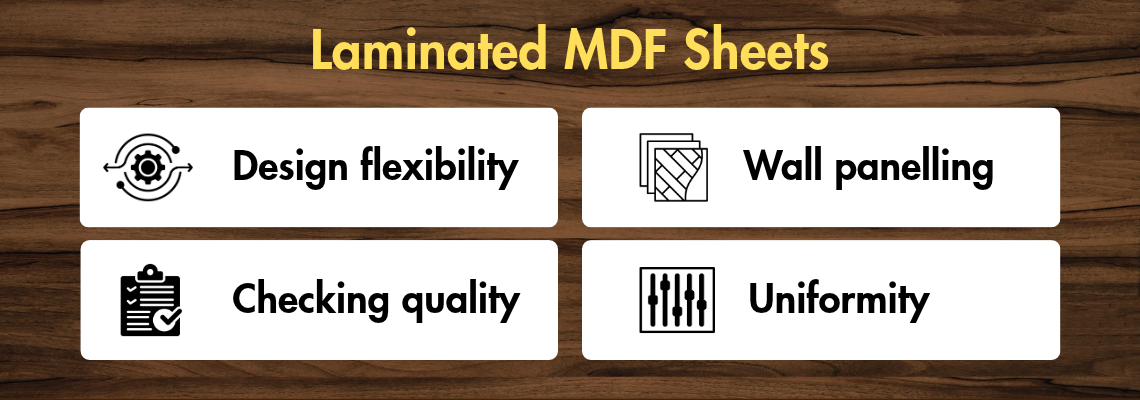
As laminated sheets are produced in one running they will be uniform. This can be very useful on a feature wall.
Design flexibility
The lack of grain allows for clean lines and shapes to be formed. It is quick to manufacture. As the laminated sheet is finished in the factory, long drying times associated with paint and pressing are avoided. Therefore installers simply have to cut, fit and edgeband. Laminated MDF is best suited to wall panelling. If thin panels are used, extra support must be added to reduce warping. Consideration must be given to joints. Leave small gaps in the joints to account for expansion and contraction due to humidity changes. Shadow joints or intentional grooves can be added to cover these gaps.
Limitations
If a project requires hand applied veneering/colour, plain MDF may be a better option.
Wall panelling
Flatness of the material is very apparent in wall panelling. Panels are usually fitted to battens. If using thin panels, extra support must be added to prevent warping. By using regular patterns (slats/flutes etc) joints can be disguised effectively. MDF is unsuitable for external wall panelling in damp or humid environments or near bathrooms. MDF is also limited by fire ratings.
Suitability In Cabinet Building
Yes (with limitations). Laminated MDF boards are a good option for wardrobe doors, storage in an office, display cabinets and kitchen doors. They give a hard, wipeable surface. However, laminated boards have limitations in terms of strength at edges. Due to the nature of MDF, screws can often pull out of the board along the grain. Good quality fittings should be used. Ensure that hinges are not placed too close to the edges of the cut.
It is generally a good idea to construct the body of a cabinet from either Particle board, and laminated MDF boards for doors and visible areas only. This provides a good finish and quality edge, whilst providing strength to the body of the cabinet.
Reasons For High Use Of Laminated MDF Boards In Retail Fit Out
Retail Fit out projects take place quickly, and often involve multiple locations. Often a new display is set up within a few seasons. Laminated MDF can help this happen as the MDF panels can easily be reproduced and can be quickly put in place.
MDF is great for creating a good surface for graphics/signage. It can be used for displays on counters. As they are in high traffic areas, protective measures should be taken in sensitive areas. Corners in particular are vulnerable. It may be a good idea to add protection to these areas with ply or other materials.
How Does Laminated MDF Compare with Plywood and Particle Board?
| Factor | Laminated MDF | Plywood | Laminated particle board |
| Surface smoothness | Excellent | Needs finishing | Good |
| Routing and profiles | Excellent | Limited | Limited |
| Structural strength | Moderate | High | Moderate |
| Screw holding at edges | Moderate | High | Moderate |
| Moisture tolerance | Needs MR grade and sealed edges | Better, especially in water-resistant grades | Needs MR grade and sealed edges |
| Typical use | Shutters, wall panels, displays | Frames, load-bearing parts | Carcasses, dry storage |
Which Thickness and Size Should You Choose?
| Thickness | Typical use |
| 6 mm | Cabinet backs, drawer bases, light cladding on a solid substrate |
| 12 mm | Wall panelling on battens, partitions, display backs |
| 15 mm | Shelves with short spans, shutters, retail fixtures |
| 18 mm | Cabinet carcasses, long shelves, counters |
| 25 mm | Heavy shelving, worktops and load-bearing panels |
Price Considerations
Multiple factors affect the price of laminated MDF sheets. Firstly consider the grade. Standard grades are cheaper than moisture and/or fire retardant grades. Thicker and larger sheets will be more expensive due to requiring more material. Finally consider the design of the sheet. If the sheet has a complicated design (high gloss and/texture) and/ or laminates, it will be more expensive than plain colours.
Volume discounts are typical in MDF. However, due to the size, delivery and handling costs increase the total landed costs. The best way to compare price quotes is to consider the cost per installed panel. When calculating this, consider wastage and rejection rates (especially if there are any issues with quality control in delivery). Even if a sheet is slightly more expensive, if it results in a lower rejection rate, the total price may be cheaper. For current pricing please provide the following information to the Xylosuisse team: Grade, Thickness, Finish and Quantity.
Checking Quality
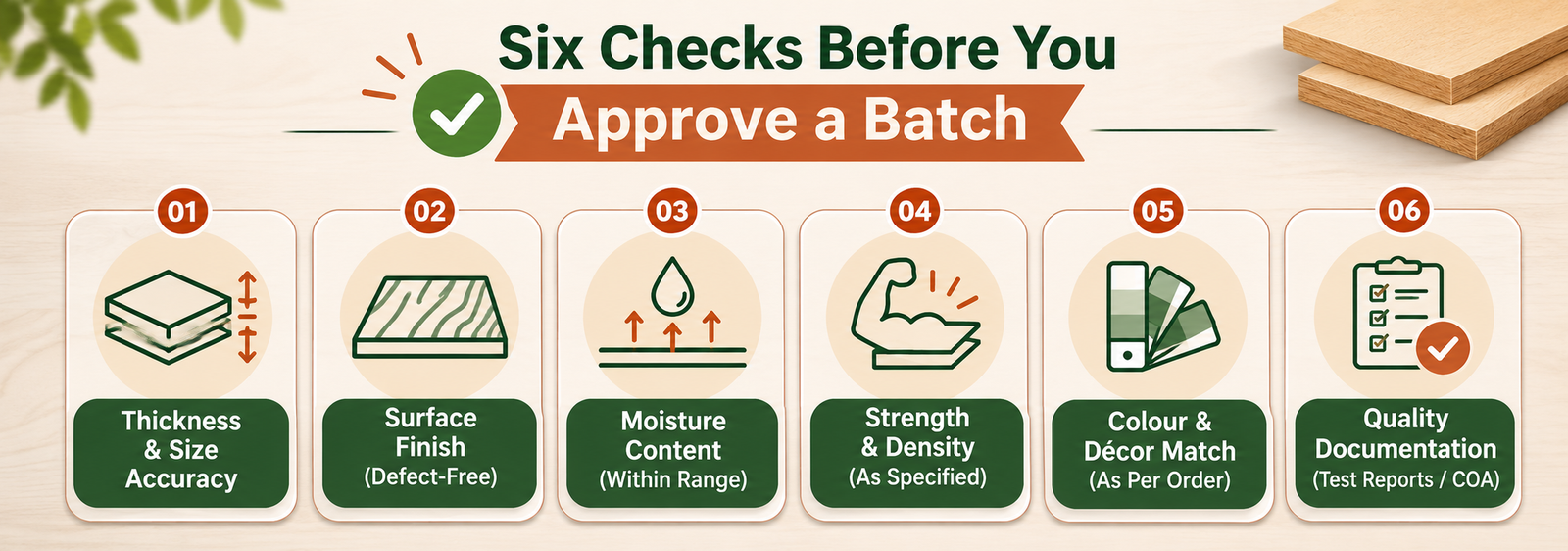
Check for quality in the sheet in the following ways. First, view the surface at an angle to make imperfections such as pitting and scratching more visible. View for unevenness in colouring. Next, check edges and corners for delamination. This may indicate poor adhesion between the core and laminate. Finally, make a fresh cut to the sheet and check for smooth and tight core. Fibre should not come out of the core.
Measure the thickness of a number of sheets. If boards are uneven this can result in gaping joints and edges. Try cutting a piece of sheet in a CNC machine/edgebander to see if chips have occurred at the cut line. Request evidence of emissions compliance. It is a good idea to keep a sample from each delivery to compare between batches.
Handling and Storing Onsite
Many problems with MDF sheets can occur onsite. Store sheets flat, in even levels and off the ground. If stacking high sheets, place spacers between sheets. Allow the sheets to acclimise in the room for 1-2 days. Lift sheets by the edges to prevent chipping and scratching of the surface.
FAQ
Suitable for wall panelling?
Yes (with considerations). Can be fitted to battens with spacing to allow for movement. Trims or grooves can be added to disguise joints. Avoid using in damp or external walls.
What can laminated MDF be used for?
Damp free internal areas. Fitted to battens with spacing to allow for movement. Use trims or grooves to hide joints. Avoid using in damp or external walls.
What is the difference between laminated MDF boards and pre-laminated MDF sheets?
There is generally no difference. Both refer to a decorative surface on MDF, added in manufacturing. Confirm whether the surface is melamine, HPL or foil.
Is laminated MDF suitable for kitchens?
Yes (for doors and dry areas). If using moisture resistant grades and sealed edges. For bodies of cabinets near sinks, water resistant ply is a safer option.
How is price decided for laminated MDF sheets?
Price is dependant on core grade, thickness, sheet size, design, single/double sided, quantity, delivery and other factors. It is best to compare price per installed panel.