
Overview
Running a furniture workshop means dealing with a lot of time pressures. One is the constant need to balance your time between the various stages of manufacture (cutting, preparing, assembling, etc). For a busy workshop, the biggest time pressure is sanding, gluing, and curing laminate. It’s a slow process that eats away at a lot of time.
Because of the time-pressure of sanding, gluing, and curing laminate, many furniture manufacturers have begun to use pre-laminated MDF sheets instead. As these sheets are laminated at the factory, all the finishing work is done and the sheets are ready to be used. This means that the process can move from cutting to assembling without any waiting time.
In this article, I will go into detail about how this material can save time, where it will not, and how to determine whether it’s right for your production methods.
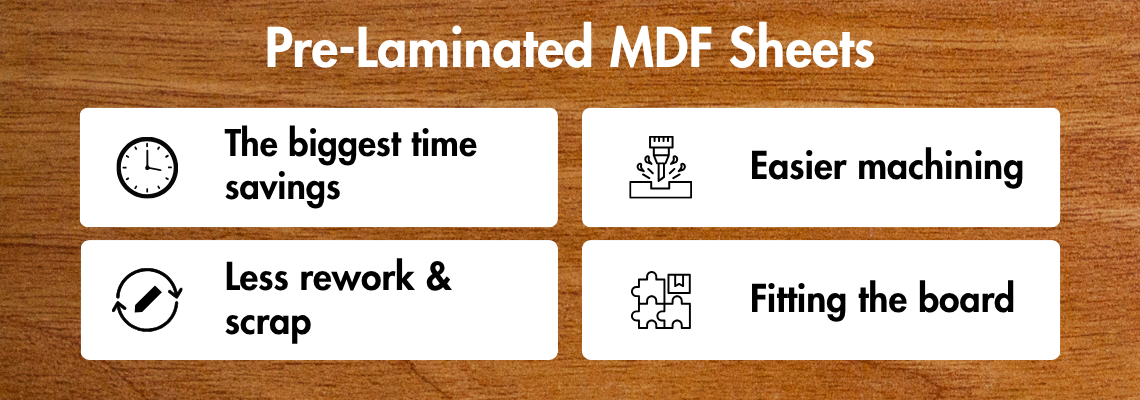
The Biggest Time Savings
The most obvious benefit of using pre-laminated MDF sheets is that the sanding, gluing, and curing process is completely removed from your production process.
Panels can be edge-banded and assembled immediately after being cut.
Because the finishing process is removed, the floor space and machinery that is typically tied up in the finishing process is now free to be used for other things.
Limitations: Of course, edge banding must still be done, and it cannot be completely removed from your process, so adjust your planning accordingly.
Easier Machining
MDF has no knots, so the grain is uniform throughout the entire board and there is no variation, making it easier to control on a CNC. The edges will not chip like other materials and elaborate shutter designs can be made easier. MDF has no knots or grain like other materials, making cutting much cleaner.
Limitation: The thin layers are easy to machine But it doesn’t hold screws as well as plywood. So hinges and slides may need reinforcement.
Less Rework and Scrap
Time is lost in slow steps, and even more time is lost in redoing work that didn’t turn out right.
Factory finish for consistent colour and texture through and through.
Completion is on site, (some colour and texture variations are normal and those are normally avoided).
Limitation: consistency dependent on supplier. Weak bond between layers can cause delaminating. Prior to cutting, you should check a few sheets from each shipment.
Fitting the Board
You need a good balance to make furniture last. A couple quick points:
Good Fit: For cabinets, office partitions, display units, panels and mouldings in dry or moderate humidity areas.
Use With Care: Kitchen furniture and fittings should be of moisture resistant grade and well-sealed at edges.
Better with plywood: load bearing units and deep shelving
Advanced workshops simply mix materials, laminating MDF when finish matters and using plywood when strength matters.
Planning Lead Times Realistically
- A direct comment: speed in the workshop can be negated if supply is unreliable.
- Confirm lead times and stock availability of finishes required.
- Order larger quantities for large projects to account for supply shortages. This will avoid delays for larger projects.
Pre-laminated mdf on plywood for casework says it all. Similar benefits of MDF over plywood are cleaner cuts, batch to batch consistency and less variation in board thickness. Of course, MDF has its own drawbacks, it is moisture sensitive, has a lower screw holding ability and needs a more consistent supply. Combine with ply where strength matters most and you get the best of both worlds while keeping cost effectiveness. Use where finish and speed is the highest priority. The same line of thinking for choosing engineered wood products for casegoods is used in choosing real wood veneers for furniture at Xylosuisse.