Overview
Modular furniture like wardrobes, cabinets and shelving are a major product segment in the furniture market. One challenge with such products is matching finishes across multiple units. The other is reducing the lead time. For a large number of manufacturers and designers, pre-laminated particleboard has become the default material for such products.
Knowing the limitations of the material helps modular furniture designers and manufacturers make the right choices to avoid unnecessary issues during the use of the product.
This paper analyzes the use of prelaminated particle board in the construction of wardrobes, cabinets and shelving, and describes the core considerations for its use.
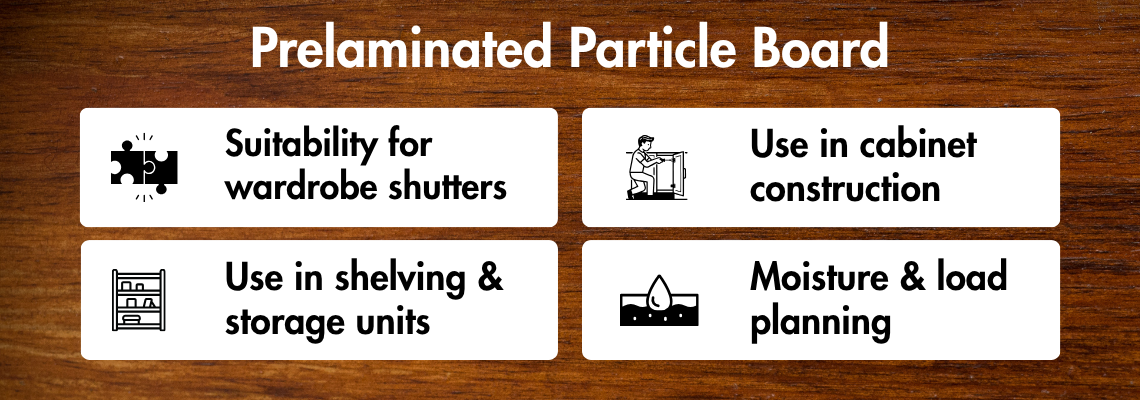
Suitability for Wardrobe Shutters
Preamagnetized particle board is used in a large number of wardrobe shutters because of the balance it offers between aesthetics and costs.
Since the laminates are pre-applied, wardrobe shutters are ready to be installed, thus eliminating the need for onsite polishing.
Large scale production of particleboard ensures uniformity in color and texture across all the units, and matters when large number of wardrobes are manufactured.
Limitation: Edge exposure needs to be covered with banding, especially in shutters, since repeated door opening and closing accelerate wear on edges over time.
Use in Cabinet Construction
Cabinets constructed from this material works well in humid conditions. However, when used in construction of cabinets for utility and kitchen areas, smooth surfaces enhance the overall look of the cabinets.
Since particle board comes in pre-defined sizes, this makes assembly of repeatable and large cabinets easy.
LIMITATION: Since particle board has less screw-holding strength compared to plywood, hinges and frequently used hardware points may need reinforced fittings, especially on cabinet doors which experience daily usage.
USE IN SHELVING AND STORAGE UNITS
Moisture exposes particle board shelving to more challenges compared to other shelving applications. However, the uniform nature of the surface allows for easier and more consistent finishes. This is important for the aesthetic appearance of open shelving units.
Particle board performs well for less demanding storage unit applications, such as display shelving and interior wardrobe shelving.
LIMITATION – For more demanding shelving applications, e.g. if heavier and sustained loads are to be supported, thicker boards or additional structural support are required. Too many spans without support can lead to sagging over time.
MOISTURE AND LOAD PLANNING FOR ALL APPLICATIONS
The grade selection should also be modified for higher moisture environments. Standard particle board is suitable for dry rooms and wardrobe interiors
MR-grade (moisture-resistant) boards are more appropriate for use near sinks and cooking areas.
If the finish compromises the density and thickness of the shelves, then there is a greater chance of shelf sag in the long run.
Designers benefit from the flexibility that the finish of the board provides them
There is a wide range of colors and textures of laminates, which enables the designer to integrate a consistent design language throughout the wardrobes, cabinets and shelving, in the same space.
From a project manager’s perspective, this gives the added benefit of shorter lead times for projects.
Conclusion
It is more a matter of balancing finish consistency and ensuring that the board is specified correctly based on the specific moisture and load requirements of a given application, than applying a single specification for all types of furniture. This material tends to be designed and manufactured according to the specific requirements, and as a result, post-installation issues are minimal and performance more consistent. Ultimately it is up to the specifier to determine if that balance has been met at the time of material selection.