
Overview
A surface comparison shows little to no difference between various particle boards available in the market. Months later, the premium board proves its worth with less sagging shelves, less swelling, and better edge alignment. The ordinary board gets loose hinges and runs the risk of failure.
These failures are costly for the entire supply chain. Architects risk their reputation with costly calls back. Developers are at risk of lawsuits due to poor workmanship. Retailers and Distributors suffer from lost sales and damaged reputation.
This guide explains what sets premium particle board brands in India apart from the rest, in measurable terms. By knowing these standards, one can evaluate the quality of particle boards without depending on looks or prices.
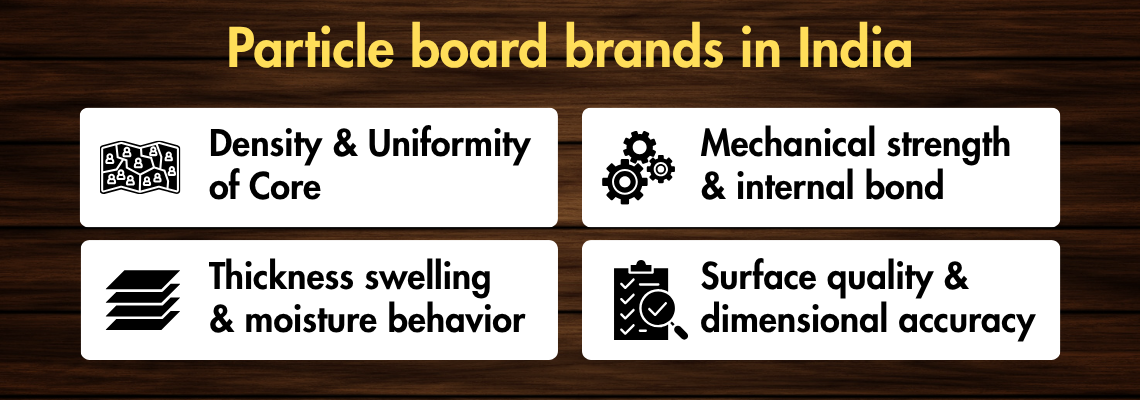
Density and Uniformity of Core
- Density is the foundation of everything else a board can do.
- Premium boards have consistent density throughout the board, which supports better screw-holding and enhanced load performance.
- Uniform distribution of particles reduces weak patches, which results in less cracking of edges around screws.
Limitation: Density is difficult to gauge by eye. One should look for specification sheets and take a sample of various batches for a comparison.
Mechanical Strength and Internal Bond
- Strengths measure the behavior of the board under actual usage conditions.
- Internal Bond measures the strength of the adhesive, which affects the board’s behavior under cutting and assembly.
- Shelves and panels supported by bending elements tend to sag over time. A board with higher bending strength resists this.
- There are some BIS (Bureau of Indian Standards) defined standards for particle boards. Boards complying with these standards provide a baseline.
Limitation: A passing test for one batch doesn’t guarantee the next, and one should do spot checks.
Thickness Swelling and Moisture Behavior
- Moisture is particle board’s worst enemy, and particularly attacks cut edges.
- Premium boards limit thickness swelling, protecting joints and finishes.
- Moisture-resistant grades are appropriate for kitchens and more humid areas.
Limitations: Even moisture-resistant boards can’t handle constant contact with water, so limits still apply to their use.
Formaldehyde Emissions and Indoor Air Quality
- Lower emission standards are increasingly dictating what boards can be purchased.
- Look for boards that have emission ratings, e.g. E1, that are documented by tests.
- Other low-emission boards assist projects in meeting green building and client health needs.
Surface Quality and Dimensional Accuracy
- Although a board can be strong, it doesn’t necessarily mean it will be easy to use on a production line.
- Square edges and consistent thickness decrease machining errors, increase yield, and reduce waste.
- A board with a flat and smooth surface is better for adhesive bonding of laminates and veneers.
- For prelaminated boards, make sure the laminate is firmly bonded to the core and not bubbling or peeling at the edges.
Traceability and Supply Consistency
- Standards only matter if they’re met every time.
- Batch-level documentation gives buyers the ability to trace batches and address issues quickly.
Dependable lead times, combined with good packing practices to protect edges during transport and storage, allow the buyer to address issues quickly. The supplier who provides the same product quality with repeat orders is the one who benefits the distributor the most.
Conclusion
There are specific factors that determine the quality of particle board and help differentiate premium particle board offerings. These factors include board density and strength, moisture behavior, chemical emissions, and consistency across batches. By systematically reviewing these factors, buyers can make more informed decisions which in turn protects the buyer’s reputation. In India, Xylosuisse, the local division of a wood panel board manufacturing group based out of Geneva, manufactures particle board and MDF Medium-density fibreboard using modern German machinery, while maintaining consistent and documented quality