
When you purchase chipboard in large quantities, you may have experienced the bad sheets that are not noticeable at the time of delivery. Those bad sheets result in bad shelves that sag and crumble and may even swell due to moisture.
For furniture manufacturers and wholesalers, the durability of chipboard panels depends on the supplier, and hence, it is essential to identify a reliable supplier, in addition to checking the chipboard
This paper describes the important factors to be considered while sourcing chipboard from the Indian manufacturing industry, to ensure that the panels are of good quality and durability, like the furniture they are used to make.
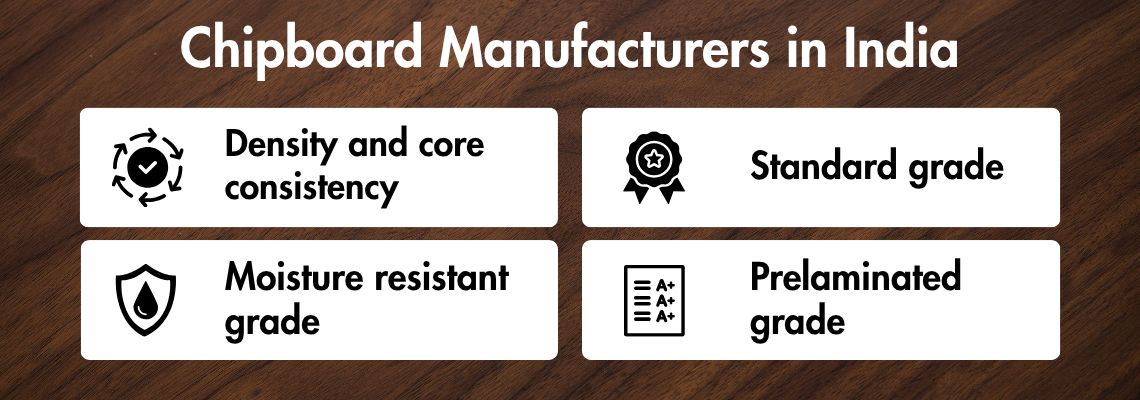
Density and Core Consistency
Density is the main factor behind the durability of chipboard. A lower density core is usually uneven, resulting in weak areas that break with the load.
Even density core ensures the chipboard holds the screws and do not sag with the load.
Limitation: Density of chipboard cannot be judged with the naked eye, and a sample’s specification should be requested and compared to judge density rather than by look and weight.
Grade Selection for Different Applications
Based on the end-use of chipboard, different grades are produced. Hence, the grade of the chipboard used should also vary with the end use.
Standard Grade: can be used for interior of wardrobes and shelves, and other furniture.
Moisture resistant grade: can be used for cabinet making in moist areas. It is not recommended to be used for areas exposed to constant moisture (like near a sink). This grade too, swells and loses shape over time.
Prelaminated Grade: This grade is used for sheet lamination in bulk and larger productions and saves time and effort.
You will overspend and/or underperform by using only one grade for all the applications mentioned above.
Administrative work may seem unappealing. However, it is a very essential part of quality assurance and helps protect your business reputation.
Check for BIS compliance and E1 rated Formaldehyde emission certificates.
Ask for test reports for large/bulk orders, especially if your clientele is Builders/Institutions.
Keep in mind that a certification for one batch has no bearing on the next, and so it is good practice to check samples regularly.
Look for consistent on time delivery of a good quality board. While evaluating sample chipboard manufacturers in India, look beyond the samples and see if they have-
What are their lead times?
- Can they ensure finish and thickness of the board is consistent across repeat orders?
- What are their measures to ensure edge damage/moisture absorption during transit?
- Rework and waste play a huge role when you are considering total cost. So while the price looks attractive, take into consideration the total cost.
- Consider the rejection rates and returns, which can quickly eat into savings.
- Boards of a mid-range, with good documentation and full certification, usually give wholesalers the steadiest margins.
Creating good purchasing habits with density and grade helps discerning buyers identify those boards that give the best value procurement. Insisting on certification, along with price and reliability sensitivity also help purchasers save on rejected shipments. These practices aid supplier confidence and strengthen long-term partnerships. Xylosuisse understands these good purchasing habits and helps manufacturers and wholesalers locate boards suited to match their furniture needs.