
Engineered wood panels are widely used in interior design and furniture manufacture due to its consistency, finish and structural durability. Among the many panel varieties available, including plywood, particle board, HDF and solid wood alternatives, MDF (Medium Density Fibreboard) has carved out a strong position for itself in residential, commercial and hospitality projects.
Designers and contractors like MDF because it has a smooth, grain-free surface, it takes delicate cuts and routed profiles, and it accepts laminates, veneers, and paint. The demand is increasing by leaps and bounds and picking the correct MDF board brand is a crucial decision for anyone in the business of interior fit-outs or furniture building.
MDF panels are not all made in the same way. The quality of wood fibres, binders, press technology and quality control procedures varied considerably between manufacturers. Cheap panels might bulge at the edges, warp or hold screws, which can lead to costly rework.
So it’s not all about price when it comes to brand selection. It’s about performance, consistency and long-term reliability.
Select the Proper MDF Board
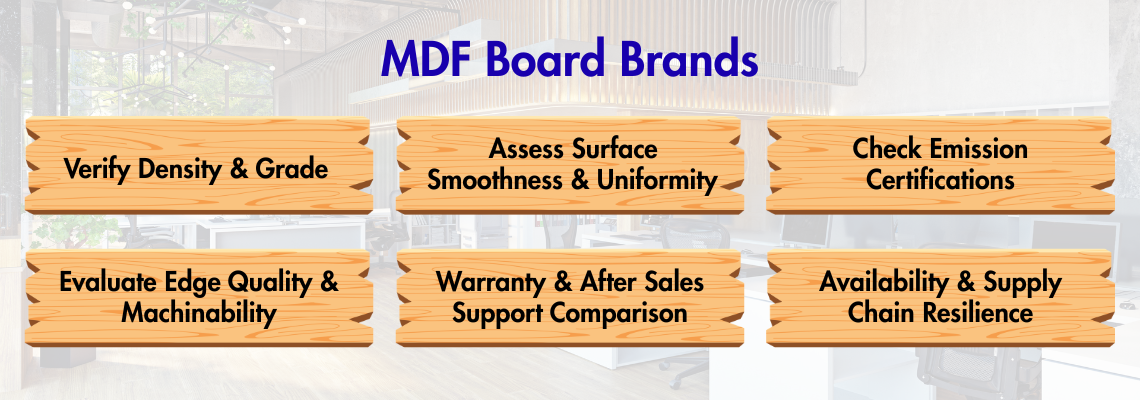
1. Verify Density and Grade
Standard, moisture resistant (MR) and fire retardant (FR) grades of MDF panels are available. Select your application before you purchase:
- Standard MDF – suitable for furniture and cabinets in a dry indoor setting
• MR Grade MDF – for kitchens, baths and wet areas
• FR Grade MDF – used for commercial applications where fire safety compliance is needed
Always check that the grade is certified specifically by the brand on its product specification sheet.
2. Assess Surface Smoothness and Uniformity
A quality panel should be smooth and consistent, with no apparent fractures, voids or density variances. Run your hand over a sample, or ask for a cut cross section. Better brands have calibrated sanding lines that give a uniform thickness from edge to edge, which is crucial when adding laminates or edge banding.
3. Check Emission Certifications
MDF can off-gas formaldehyde from the resins and glues used. The good brands are certified as E0, E1 or CARB P2, which are low emission formulas. This is especially crucial when it comes to indoor furnishings and children’s rooms. Always ask your provider for proof of emission compliance.
4. Evaluate Edge Quality and Machinability
If you’re doing CNC routing, profiling or detailed edge work on your furniture, you need panels with uniform fibre bonding through and through in the core. Test an edge sample for crumbling or delamination. With reputable brands of high density MDF, you can expect smooth cuts with minimal chipping.
5. Warranty and After Sales Support Comparison
Established brands come with tech support, warranty terms, and defined tolerances. This is particularly critical for major commercial or institutional projects because serious non-conformance might result in project delays.
6. Availability and Supply Chain Resilience
Even the greatest panel is meaningless if it can’t be supplied on time. Choose companies that have a proven track record of distribution in your area, with well-stocked inventories and solid logistics. Continuity of supply is just as important as quality of product.
Selecting the proper board is not about brand name awareness; it’s about help from a provider that knows materials inside and out.
That know-how is brought by Xylosuisse to every project discussion. Be it fitting up a luxury apartment, designing office furniture or working on a huge commercial interior, Xylosuisse helps you choose and source the most suitable mdf board brands for your individual purpose – balancing grade, emission compliance, machinability and budget.