
If you enter almost any modern home or modular kitchen, you will almost certainly find cabinetry that uses particle board as their primary building material. Particle board is the name for an engineered wood panel that is comprised of wood chips, wood shavings, and resin that are placed under heat and pressure. The Composite Panel Association refers to particle board as one of the most popular composite panels, and with good reason. Particle board offers an inexpensive and easy-to-work-with, smooth and level surface, which is especially important for cabinetry. It is useful for laminates and veneers, which is why modular furniture manufacturers and carpenters love this product as well.
Like other engineered wood products, there are certain limitations to using particle board for cabinetry. Particle board, being more sensitive to moisture and physical stress than solid wood, requires more attention to maintain its structural integrity.
Below are five maintenance tips for integrated wood cabinetry that will help reinforce structural integrity.
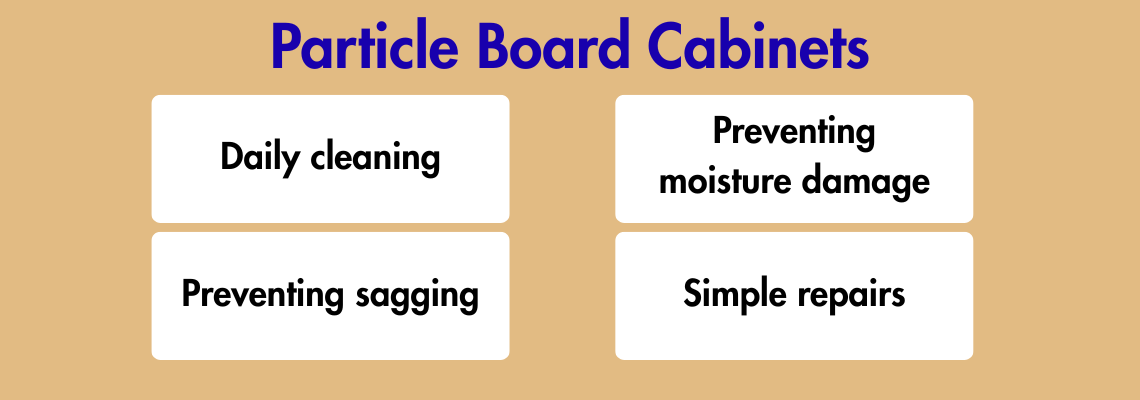
- Daily Cleaning
Cabinet surfaces are best cleaned with a dry, soft cloth and should be cleaned on a regular basis to prevent dust and dirt deposits from settling in cracks and edges. For more thorough cleaning, a cloth that is slightly damp is always better than a wet one, since excess moisture can harm engineered wood products. Cleaning cabinets regularly and gently can prevent surface stains and attract pests.
- Preventing Moisture Damage
Since particle board absorbs moisture quicker than solid timber, controlling humidity and moisture around cabinets is important. Keep cabinets away from water, and the splashes that occur in the kitchen and bathroom. Spills should be wiped away, and exhaust fans should be used to reduce the humidity in the room. Indoors humidity at a moderate level helps prevent swelling and warping while extending the cabinet lifespan significantly.
- Preventing Scratches, Stains, and Surface Damage
Cabinet surfaces can experience friction damage by stored items in the cabinet. Felt pads, coasters, and cabinet liners can all reduce friction. Layered laminate can be chipped by the direct sliding of heavy and/or sharpened edge items. For spills that are oily or have a color to them, quick cleanup should be practiced.
- Preventing Sagging
Cabinet sagging, especially in particle board shelving, can be caused by unevenly distributed weight and an overloaded shelf. Bowing can also be caused by the cumulative effect of neglecting to evenly distribute the weight. Shelf supports can be used to help maintain structural integrity.
- Simple Repairs
Minor cabinet issues, like hinge problems and wear, can be addressed by periodically checking hinges and/or putting edging back in place. Replacement of low wear cabinetry can be avoided by covers that match the previous color.
Conclusion
The longevity and appearance of cabinetry are dependent on the quality of care provided. Keeping an eye on moisture, cleaning, inspecting, and ensuring cabinets are not overloaded are some simple habits that help extend the life of particle board cabinets. Once the habits are formed, cabinets can be expected to maintain their appearance and function for years. At Xylosuisse, we know this and design our engineered wood panels to meet these simple requirements. Our wood panels provide homeowners, modular furniture manufacturers, and carpenters the strong foundation to turnkey cabinetry.